Showing posts with label PeterDrucker. Show all posts

Tuesday, November 27, 2012

Alcoa CEO: Traditional career path is "dead"


As seen on 60 minutes website

November 11, 2012 7:08 PM

Klaus Kleinfeld, CEO of aluminum company Alcoa, tells Byron Pitts that workers need a combination of education and skills that are in demand by employers.

Byron Pitts, CBS
My impression is that employers talk about education

Byron Pitts, CBS
Employees talk about income and salaries

Klaus Kleinfeld, Alcoa CEO
Yes, but they also need to understand that their incomes over time are a direct function of education. Not just their education but of their skills.
Of what they can bring to the table.

Klaus Kleinfeld, Alcoa CEO
The societal model of the past was that you were born, you were nurtured up to whatever you were 6, you went to kindergarten and school and by eighteen you come out and you go to college. When you come out of college you get a job and then you retire at age 65 and then enjoy your retirement in some hot place. Right. That's been the model of the past.

Klaus Kleinfeld, Alcoa CEO
That's not working. That's absolutely not working anymore. In every respect.

Byron Pitts, CBS
Not working or just dead?

Klaus Kleinfeld, Alcoa CEO
It's dead. I would say it's dead for every level. For every level in society. I mean everyone. Everyone.


The kids and grandkids in your family are going to grow up and older in the world ahead — 2020, 2030 ... Yet their expectations are probably based on the dead model. And the education system is still glued to the past — regardless of how much it costs.


rlaexp.com is specifically designed to provide a work approach that deals with the new challenge we all face.

If you Google the core concepts on the page above, almost all the Google search results lead only back to rlaexp.com. The uniqueness is the collection of concepts and their cross-linking all on one site.

This page above is just one of over 500 pages.

There is more world view content here than maybe Harvard's catalog. You know there is lots of stuff on Amazon that is not taught at Harvard.

The site contains a number of copyrighted concepts that I've had to work out for getting from concepts to daily action along three time-lines:

  • The changing social and economic picture
  • Organization evolution (from birth to death)
  • Career evolution in a world where life-time employment is dead

In dealing with the challenges of navigating our own way through time we need "foundationS for future directed decisionS" ©

There is nobody better than Peter Drucker to help us create our own. Some jumping off points:

Take a tour?

Monday, October 29, 2012

Economic development work approach


This posting is an introduction to the economic development aspect of rlaexp.com
http://rlaexp.com/eco.html is a doorway to a large multi-generational, multi-topic economic development brainscape and tool kit. 
The site is primarily based on Peter Drucker's work.
He is top of the food-chain. Drucker had and has THE world-beater reputation based on an approach and method different from the rest. Remembering Drucker from The Economist. 

To get a feel for the site's depth, try a Google site search for: "management site:rlaexp.com" without the quotation marks.
You can add or substitute: leadership, innovation, entrepreneurship, knowledge, technology, careers, books, time, "information literacy", concepts, thinking or investments for management to see different search results.
To summarize rlaexp.com's broad scope:
  • The changing social and economic picture
  • The evolving content and structure of the economy
  • From early career work to CEO work area landscapes which includes the second half of one's life
  • From startup through multiple stages of organization evolution
  • A system for getting from concepts to daily action — repeatedly

Together this provides a prototype life-time work approach.
The site has over 500 web pages, 1000 images, and 100 PDFs. There are literally thousands of topics to choose from.

The site consists of book outlines (some with lengthy passages), concept illustrations, harvesting and action processes, topic brainroads that concatenate quotations from a variety of sources and lots of hyperlinks between topics.
The intent of the site is to create a comprehensive bread crumb trail toward tomorrows. Imagine what someone in 1950 or 1990 had to go on.
The site gives you a menu of future facing action areas that you probably didn’t have before. It is impossible to work on things that aren’t on your radar.
The site is a prototype that can be used or modified in any way a person wishes.
The site is a result of over 30 years of full-time research and content organization. 
It originated out of my previous corporate restructuring work and involvement with over 60 organizations in a wide range of areas. 


In addition to what is available on the web site, I have a large current events database that I update daily from 90+ news sources.
What do people in various situations and communities need on their radar as we move deeper into the 21st Century — a society of organizations, a knowledge society, and a network society? How will they get it?
I'm in the process of introducing the site to people in the economic development community — state economic development agencies and the chamber of commerce. The reaction so far has been underwhelming. Actually I haven't talked with anyone who knows who Peter Drucker was or knows his impact on society and the economy. From what I've seen so far they are spending money on trying to bring back yesterdayS.


Tuesday, July 31, 2012

rlaexp.com lives — the future is between the ears

rlaexp.com provides brainroads for creating foundations for future directed decisions — what you need to know before you decide to do or not do. There are over 500+ web pages that mainly rest on Peter Drucker's shoulders. rla = Real Life Adventures and exp = Exploration. TomorrowS aren't going to be more up-to-date versions of 1950, 1980, or 2000 and you can't get there by stacking up more TodayS.


Attention: look, what do you see?


The home page is a long introductory brainroad for attention directing and future directed foundation creation. Just reading is of little value without calendarization or adding the "right stuff" to your radar list.

Saturday, May 19, 2012

Inside Drucker's Brain


The most accessible guide to the essential ideas of "the inventor of modern management".

In late 2003, ninety-four-year-old Peter Drucker invited Jeffrey Krames to his home for an unprecedented day-long interview. He spoke candidly about his seminal management principles, his enormous body of work (thirty-eight books over six decades), and the leaders he had advised over the years (including Jack Welch).

Krames used the insights he gained that day to create "Inside Drucker's Brain"—a compact guide to the great man's wisdom. Krames had no intention of writing a biography, but rather a book that would showcase Drucker's most important ideas and strategies, and explain why they are just as useful today as they were decades ago


Thursday, May 17, 2012

A view of the education landscape

Recent opinions:


An extended landscape view


Learning has addition thoughts by Peter Drucker. Find education, teaching, and learning related topics in Drucker's books.

The future of America lies between the ears of Americans and I'm not just talking about subject knowledge.

Wednesday, May 16, 2012

Lasting Value: Lessons from a Century of Agility at Lincoln Electric

Joe's Journal: On Bringing More Knowledge to Manufacturing
A while back, I wrote the book Lasting Value, which featured the stories of such high-productivity U.S. manufacturing companies as Lincoln Electric and the steelmaker NUCOR

 Amazon book page

In its 104-year history, Lincoln Electric Company has managed to sustain its status as the world's leader in welding technology despite intense domestic and foreign competition. The company's success can be attributed to founder James Lincoln, who began adopting principles of management that empowered workers and allowed the company to change rapidly to take advantage of new opportunities. This book shows you how to duplicate these pioneering ideas and follow the brilliance of the Lincoln management system. The results of this system include happier customers, more prosperous workers, and richly rewarded shareholders. 
... Joseph Maciariello uncovers Lincoln's approach to management in a systematic manner and demonstrates why the company has been so effective for over a century. You'll discover how Lincoln employs a mutually reinforcing set of management systems that creates a boost in overall performance. When these systems are described and understood in their entirety, you'll see how the company's sustained success is due to its natural development of agility. You'll findout how this agility is connected to its executive leadership, management systems, and cultural environment. And you'll learn how to utilize these principles and techniques in your own company to obtain similar results. 
... By implementing this system, you can also experience these strong financial returns for shareholders, an increase in wages for workers, higher productivity, and much more!
"Lasting Value is that rarest of books: a "why to" book, a "what to" book, and a "how to" book- its examples deal with manufacturing companies and blue-collar workers. But the lessons have particular force for the new job facing management: building organizations of knowledge workers who perform and who create lasting value." — Peter F. Drucker 
"In today's world of quarterly expectations and Wall Street's praise for major restructuring, Lasting Value successfully illustrates that long-term shareholder value can occur when corporations are truly customer and employee driven with the highest of motives."
I just bought a copy.

Saturday, May 5, 2012

Technology as human work

From chapter three of Technology, Management and Society by Peter Drucker

Man, alone of all animals, is capable of purposeful, nonorganic evolution; he makes tools. This observation by Alfred Russell Wallace, codiscoverer with Darwin of the theory of evolution, may seem obvious if not trite. But it is a profound insight. And though made some seventy or eighty years ago, its implications, have yet to be thought through by biologists and technologists. 
One such implication is that from a biologist's (or a historian's) point of view, the technologist's identification of tool with material artifact is quite arbitrary. Language, too, is a tool, and so are all abstract concepts. This does not mean that the technologist's definition should be discarded. All human disciplines rest after all on similarly arbitrary distinctions. But it does mean that technologists ought to be conscious of the artificiality of their definition and careful lest it become a barrier rather than a help to knowledge and understanding
This is particularly relevant for the history of technology, I believe. According to the technologist's definition of "tool," the abacus and the geometer's compass are normally considered technology, but the multiplication table or table of logarithms is not. Yet this arbitrary division makes all but impossible the understanding of so important a subject as the development of the technology of mathematics. Similarly the technologist's elimination of the fine arts from his field of vision blinds the historian of technology to an understanding of the relationship between scientific knowledge and technology.… snip, snip … For scientific thought and knowledge were married to the fine arts, at least in the West, long before they even got on speaking terms with the mechanical crafts: … snip, snip …  
Even within the technologist's definition of technology as dealing with mechanical artifacts alone, Wallace's insight has major relevance. The subject matter of technology, according to the Preface to History of Technology, is "how things are done or made"; and most students of technology, to my knowledge, agree with this. But the Wallace insight leads to a different definition: the subject matter of technology would be "how man does or makes." As to the meaning and end of technology, the same source, again presenting the general view, defines them as "mastery of his (man's) natural environment." Oh no, the Wallace insight would say (and in rather shocked tones): the purpose is to overcome man's own natural, i.e., animal, limitations. Technology enables man, a landbound biped, without gills, fins, or wings, to be at home in the water or in the air. It enables an animal with very poor body insulation, that is, a subtropical animal, to live in all climate zones. It enables one of the weakest and slowest of the primates to add to his own strength that of elephant or ox, and to his own speed that of the horse. It enables him to push his life span from his "natural" twenty years or so to threescore years and ten; it even enables him to forget that natural death is death from predators, disease, starvation, or accident, and to call death from natural causes that which has never been observed in wild animals: death from organic decay in old age
These developments of man have, of course, had impact on his natural environment—though I suspect that until recent days the impact has been very slight indeed. But this impact on nature outside of man is incidental. What really matters is that all these developments alter man's biological capacity—and not through the random genetic mutation of biological evolution but through the purposeful nonorganic development we call technology. 
What I have called here the "Wallace insight," that is, the approach from human biology, thus leads to the conclusion that technology is not about things: tools, processes, and products. It is about work: the specifically human activity by means of which man pushes back the limitations of the iron biological law which condemns all other animals to devote all their time and energy to keeping themselves alive for the next day, if not for the next hour. The same conclusion would be reached, by the way, from any approach, for instance, from that of the anthropologist's "culture," that does not mistake technology for a phenomenon of the physical universe. We might define technology as human action on physical objects or as a set of physical objects characterized by serving human purposes. Either way the realm and subject matter of the study of technology would be human work.

Peter Drucker was a social ecologist.

Tuesday, May 1, 2012

Barriers to Innovation


The first barrier is the general confusion over innovation and entrepreneurship. There are people who know something about it and people who sling the words around without the slightest investigation or understanding. They then use their "man on the street" assumptions in their thinking and decisions which have a high probability of failure.

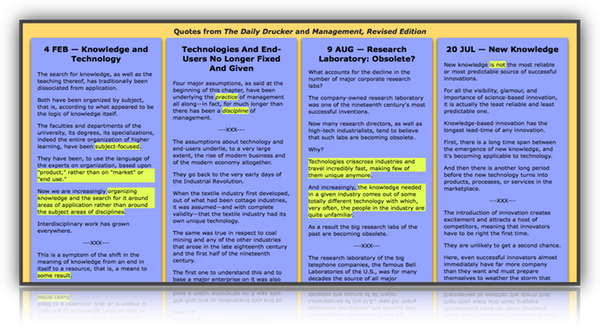
The other main barriers are covered in Innovation and Entrepreneurship and Management, Revised Edition (search for the word stems "innovat" and then "entrepren")


Tuesday, April 24, 2012

If it says innovation it probably isn't

Ads that contain the words innovative or innovation are not likely to be either.

Real innovations don't need or want this language — they are a distraction.


Just show us what it is and what it will do for us. Remember when iPods or iPhones or iPads were new? Just show us the magic and let that sell it.

If it has been set up as a separate "entity" then the management believes it is an innovation otherwise it is probably hype.

Monday, April 23, 2012

Some Drucker thoughts on corporate misconduct

The case against Lehman Brothers and Wal-Mart probe could cost some executives their jobs.

From Chapter 14 — "The Mystique of the Business Leader" in Managing for the Future

… snip, snip … 
Business executives are inevitably leaders in their organizations, seen as such, perceived as such, judged as such. 
"The higher up the monkey goes, the more of his behind he shows," runs an English schoolboy jingle. What executives do, what they believe and value, what they reward and whom, are watched, seen, and minutely interpreted throughout the whole organization. And nothing is noticed more quickly—and considered more significant—than a discrepancy between what executives preach and what they expect their associates to practice.
Recently I discussed with an elder statesman of Japan's industry the violation of the ban on strategic shipments of American products by a subsidiary of Tokyo's Toshiba. I commented on the fact that the top executives of Toshiba had held themselves "accountable" and resigned over this matter even though the violator is barely controlled by Toshiba (which holds only 50.1 percent of its stock), is autonomous, and had disregarded published company policy. 
"We wouldn't say 'accountable,' " my friend said. "We'd say: 'It's their fault.' If a manager in a company does something wrong to improve the market standing or the profits of the company, you can be sure that he only does what his top management wants him to do and signals him to do." 
The Japanese recognize that there are really only two demands of leadership. One is to accept that rank does not confer privileges; it entails responsibilities. The other is to acknowledge that leaders in an organization need to impose on themselves that congruence between deeds and words, between behavior and professed beliefs and values, that we call "personal integrity."

Tuesday, April 17, 2012

Leadership


There is so much leadership blah, blah, blah (snake oil) and then there is Peter Drucker.
Leadership is lifting a person's vision to higher sights, the raising of a person's performance to a higher standard, the building of a personality beyond its normal limitations. 
Nothing better prepares the ground for such leadership than a spirit of management that confirms in the day-to-day practices of the organization strict principles of conduct and responsibility, high standards of performance, and respect for individuals and their work. 
Peter Drucker with Joseph A. Maciariello, Management, Revised Edition
More of Drucker's thoughts on leadership

Why Great Leaders Are in Short Supply

Spencer Stuart's Tom Neff, the dean of CEO Executive Search, puts it baldly: "We are experiencing a demand for new types of skills and sacrifices in C-level executives that many are not prepared to bring to the table."

tlnkwleadership

Thursday, April 12, 2012

Drucker, marketing, branding


In Tiny Product Change, Huge Sales Impact: The Billion Dollar Branding Lesson from Morton Salt the author states: "Peter Drucker has famously said that the only job of a business is to create customers.  He hasn’t said exactly how to do it.  That’s where branding comes in."
Drucker did offer advice on how to create a customer. Chapter 9 "The Purpose and Objectives of a Business" in Drucker's Management, Revised Edition  offers a different thought process. It is fairly lengthy and there is a major, major, major danger in quoting him out of the larger context.
The word "brand" is not the focus of Drucker's thinking. He would probably point out the long list of dead brands.
"… snip, snip … The profit motive and its offspring maximization of profits are just as irrelevant to the function of a business, the purpose of a business, and the job of managing a business … snip, snip … It is a major cause for the misunderstanding of the nature of profit in our society and for hostility profit, which are among the most dangerous diseases of a society or (of) organizations. It is largely responsible for the worst mistakes of public policy—in this country well as in Western Europe—which are squarely based on the failure to understand, the nature, function, and purpose of business enterprise.
… snip, snip … Above all, consumerism should dispel the confusion which largely explains why there has been so little real marketing.
When managers speak of marketing, they usually mean the organized performance of all selling functions.
This is still selling.
It still starts out with "our products."
It still looks for "our market."
True marketing starts out … snip, snip … with the customer, his demographics, his realities, his needs, his values.
It does not ask, "What do we want to sell?"
It asks, "What does the customer want to buy?"
It does not say, "This is what our product or service does."
It says, "These are the satisfactions the customer looks for, values and needs … snip, snip …
Indeed, selling and marketing are antithetical rather than synonymous or even complementary.
Marketing alone does not make a business enterprise … snip, snip …
The second function of a business is, therefore, innovation—the provision of different economic satisfactions … snip, snip …"
Even the quotes above are a misrepresentation of Drucker's mental landscape. Also see chapter 8 The Theory of the Business.

Also see The Definitive Drucker and Marketing in Crisis

Monday, September 12, 2011

Monday, August 22, 2011

The CEOs astounding balancing act

From The Definitive Drucker
… I've touched on failure, so I should mention success. Six of Business Week's top ten fastest-growing small American companies, and seven of the ten companies that have shown the greatest equity value gains over the last five years, didn't even exist twenty years ago. This dramatic performance highlights a key challenge to CEOs: to wrest the ability to challenge assumptions and redefine the way business is done from the financial markets. Up until now, the venture capital and equity markets have served as the primary vehicles for creating new ways of doing business and even innovation—closing companies and opening new ones. Sure, shareholders liked this power, but it flies in the face of the business's need to sustain itself. Ultimately this short-term obsession with results is closing down businesses, displacing employees, and ruining communities. It is the CEO's responsibility to use his or her uniquely broad field of vision to challenge the status quo when answering the question "What is needed?" so that companies and communities can remain viable. On top of everything else, CEOs must do an astounding balancing act: They must lead the enterprise for the customers and employees and accommodate, but not bow to, the harsh demands of the stock market.

Tuesday, August 9, 2011

The Transformation


"EVERY FEW HUNDRED YEARS in Western history there occurs a sharp transformation. We cross what in an earlier book, I called a "divide." See The New Realities—1989.

Within a few short decades, society rearranges itself—its worldview; its basic values; its social and political structure; its arts; its key institutions. Fifty years later, there is a new world. And the people born then cannot even imagine the world in which their grandparents lived and into which their own parents were born.

We are currently living through just such a transformation. It is creating the post-capitalist society, which is the subject of this book: Post Capitalist Society contents


Knowledge worker challenges


Knowledge workers tend to identify at least as much with their knowledge discipline as they do with the organization in which they are employed. This creates new challenges for managers, because knowledge workers are highly mobile and more difficult to integrate into the mission of the organization. Peter Drucker